FIELD NOTE # 001

The Wall that Remembered Green
{ on memories and records }
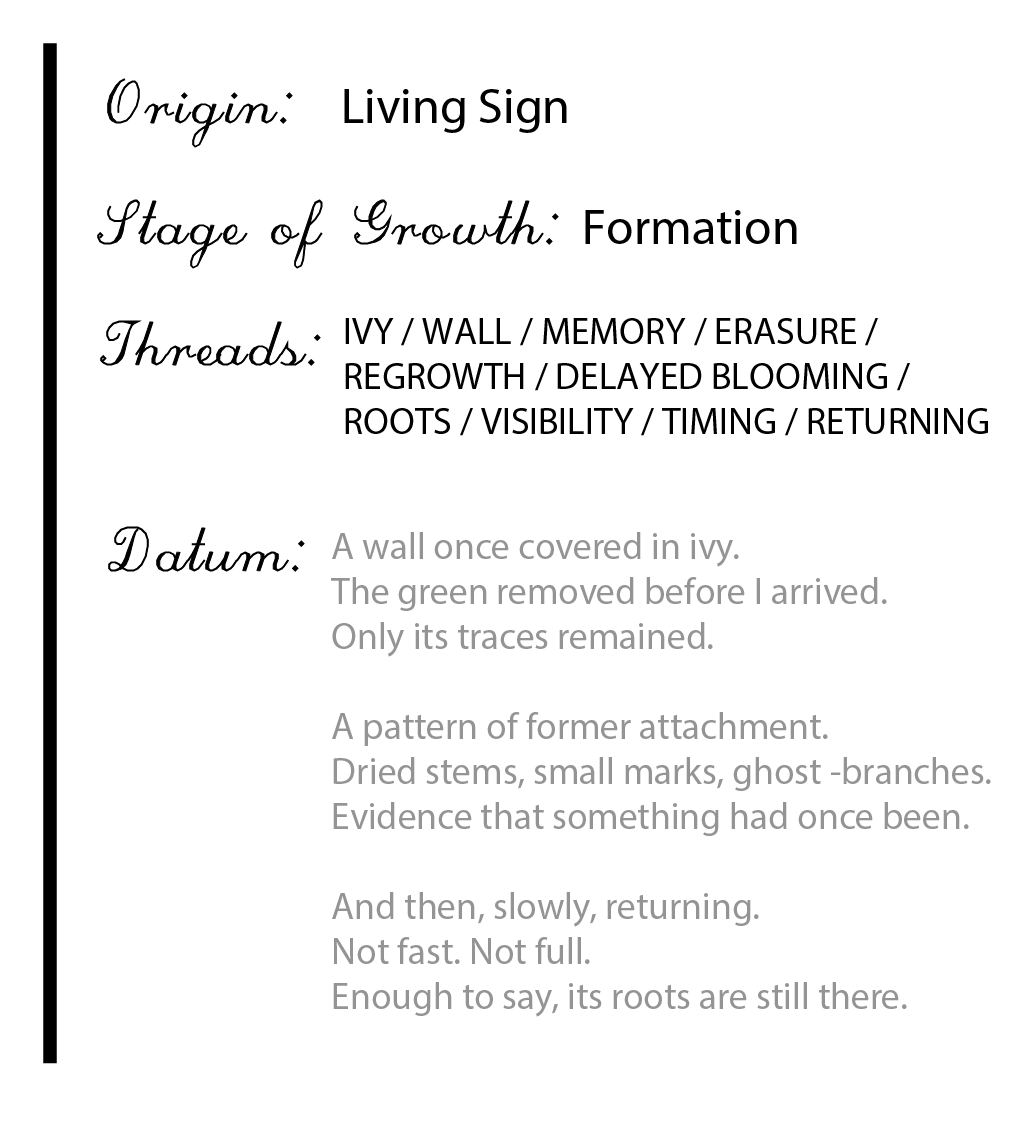
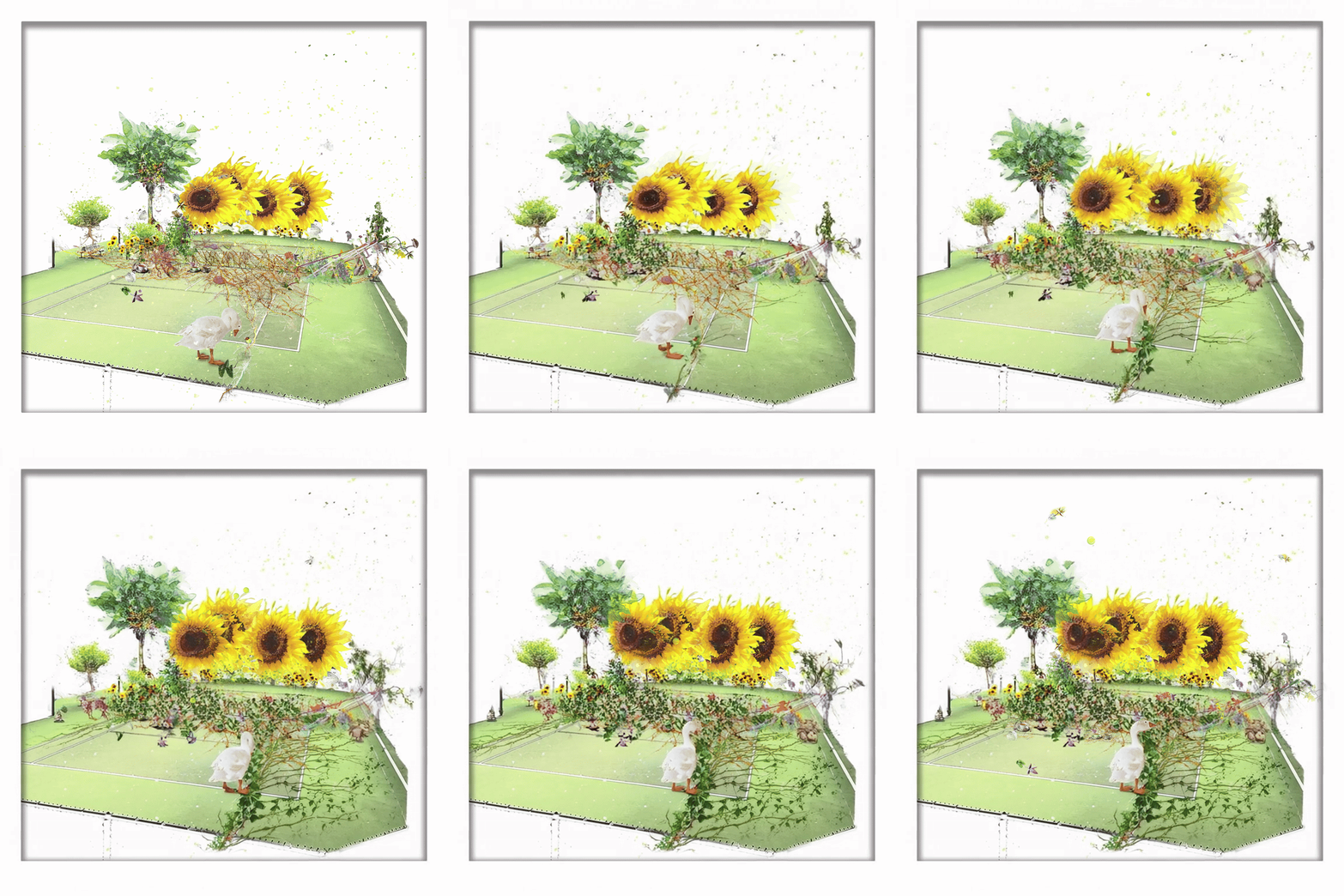
Outside my window, there is a wall that used to be covered in ivy.
I know this because I saw it in the old apartment listing: a large window looking out onto a living field, a wall softened with green. It felt special to me — the idea of living in an urban surrounding with its own secret vertical garden, shielding me softly from the world. My room, a sanctuary. A haven for creatures that roam, nest, and play. It was my garden, and it was a boundary with its own living field.
But when I moved in, the green was gone.
No field. Only a bare wall.
And yet it was not truly bare. It still carried the evidence of what had once grown there: thin brown lines, dried tendrils, little marks where leaves and stems had attached themselves while the wall was once in full bloom. What remained was the memory of its presence — traces of where life had once climbed, no longer visible within this current timeline.
That first year, a small strip of green tried to return.
It grew from the side cautiously, as if testing whether the wall would allow it back. For a moment, it seemed possible. Then it thinned, weakened, and disappeared again.
I wondered if the wall had been poisoned to stop the growth.
It could no longer grow along the same paths it once had because the path was no longer viable. I wondered whether the ivy would one day try to return, even though its conditions had been made hostile to it.
And now, this year, I watch as it tries once again.
The leaves are fuller than last year’s, but still hesitant. They seem to reach outward carefully, as if remembering where they had once tread while also recalling what happened the last time they tried. Maybe it will overcome its fear this year. Maybe it will try again next year. Maybe it is simply re-establishing its footing as it remembers — and recalibrates — how to bloom again.
How easy it is to look at something and decide it should be growing faster.
How easy it is to judge a life by the surface of what blooms.
And yet every bloom unfolds in its own timing, within its own conditions, according to what makes sense to its roots — and perhaps only to them.
For what its roots are makes its being at its core.
How something finds its way toward blooming, the way it needs to bloom and wants to bloom, is a story only it can truly know.
Life is a process of learning how to flourish in its own way.
Inch by inch.
Step by step.
One footing at a time.
Sometimes it must relearn how its field should bloom, carrying memory from previous seasons while still searching for new ground. Through the memory of its roots, it grows its blooms. It reveals itself as it was always meant to become.
This is an observation about how things grow, how things bloom, and how some lives require longer seasons before they can fully open.
Some things do not bloom late because they lacked will.
Some things bloom late because the conditions were not right.
Some things had their buds cut before they could reach the light.
Some things had to spend years re-establishing their roots before they could grow again.
The ivy is returning, and return is its own form of growth.
It may not grow back in the same formation it once held, but perhaps it will grow into something even more beautiful than before.
Blooming is not only a matter of maturity, timing, or effort.
Blooming is also memory.
Environment.
Care.
Safety.
Root.
Light - light of all kinds, whatever it means to you.
The wall still remembers green.
The roots have always been there to remind it.
And somewhere, slowly, a surface that was once stripped bare is learning how to reveal its living system again — perhaps with even more clarity and beauty than before.